Minivan in Munich with Chauffeur
-
Up to 7 passengers with luggage
-
Infant carrier, child seat & booster seat free of charge
-
Fixed price before booking – no taximeter
-
60 minutes free waiting time at the airport
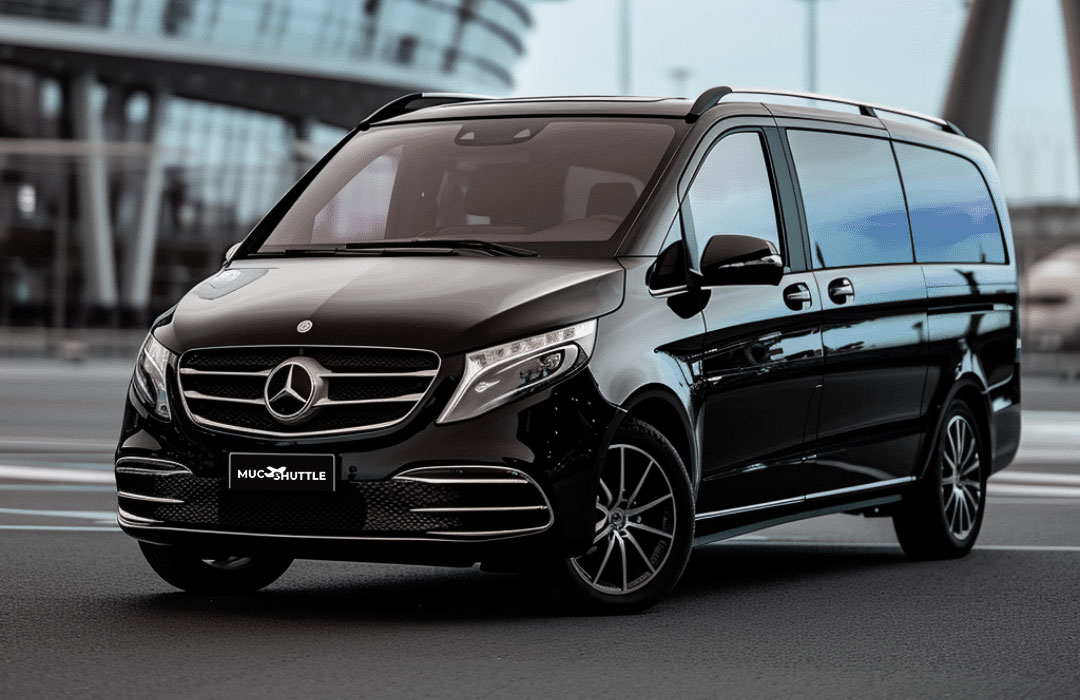
Travelling together – relaxed and safe. With pushchairs, suitcases and child seats, any airport transfer can quickly become a challenge. In our minivan, the Mercedes-Benz V-Class, your family or group travels together in one vehicle – with plenty of room for luggage and a chauffeur who helps with loading and unloading.
For families with babies and young children, we bring the right infant carrier, child seat or booster seat free of charge. You don’t have to carry anything or fit anything in the car – simply state your children’s age, height and weight when booking. For smaller groups without children, you will find more information on our page Van transfer for up to 7 people.
Your benefits in the minivan
-
Room for up to 7 passengers and large luggage, pushchairs or ski equipment
-
Free infant carriers, child seats and booster seats – matched to height and weight
-
Pickup at Munich Airport with flight tracking and name sign
-
Fixed price before booking – no taximeter and no hidden costs
-
Chauffeur helps with luggage and with getting in and out
Who is the minivan ideal for?
-
Families with babies and young children
-
Grandparents, parents and children travelling together
-
Groups and teams with lots of luggage
-
Skiers on their way to the Alps
Good to know
-
Please state the number, age, height and weight of the children when booking
-
You are also welcome to bring your own child seat
-
Wi-Fi and water on board
-
Also for city-to-city journeys and hotel transfers
Vehicles
-
Premium Van XL: Mercedes-Benz V-Class – up to 6 passengers with 6 pieces of luggage
-
Premium Van XXL: Mercedes-Benz V-Class – up to 7 passengers
-
Several vehicles for larger families and groups
Which child seat suits my child?
A child seat only protects properly if it matches your child’s height and weight. A seat that is too large does not hold the child firmly enough; in a seat that is too small, the head sits above the backrest. The overview below shows the stages your child goes through from day one until around their 12th birthday. We bring the right seat for every stage free of charge.
Infant carrier
- Height (i-Size, R129)
- approx. 40 – 87 cm
- Weight (ECE R44)
- up to 13 kg (Group 0+)
- Age (guideline)
- birth to approx. 15 months
- Installation
- always rear-facing
Toddler seat
- Height (i-Size, R129)
- approx. 76 – 105 cm
- Weight (ECE R44)
- 9 – 18 kg (Group I)
- Age (guideline)
- approx. 15 months to 4 years
- Installation
- ideally rear-facing for as long as possible (reboarder), with five-point harness or impact shield
High-back booster seat
- Height (i-Size, R129)
- approx. 100 – 150 cm
- Weight (ECE R44)
- 15 – 36 kg (Group II/III)
- Age (guideline)
- approx. 4 to 12 years
- Installation
- forward-facing, with the vehicle's three-point belt – belt routed over the shoulder and pelvis
Booster cushion without backrest
- Height (i-Size, R129)
- approx. 125 – 150 cm
- Weight (ECE R44)
- 22 – 36 kg (Group III)
- Age (guideline)
- approx. 7 to 12 years
- Installation
- forward-facing, with the three-point belt – raises the child so that the lap belt lies across the pelvis. A seat with a backrest also provides side-impact protection.
Standard seat belt
- Legal threshold
- from 150 cm in height or from the 12th birthday
- Important
- The shoulder belt must run over the shoulder – not across the neck – and the lap belt low across the pelvis.
Ages are guidelines only. What matters is your child's height or weight and the approval on the seat's test label. New child seats are approved under UN R129 (i-Size) and classified by height, older ones under ECE R44 by weight – both may be used.
Why the right child seat matters so much
An accident can happen to anyone – even through no fault of your own. Our chauffeurs drive with foresight and experience. But no one can prevent another road user from rear-ending us, missing a red light or braking suddenly on the motorway. The right child seat is there for exactly that moment, which is out of your own hands.
The forces acting on a child in a collision at 50 km/h
At 50 km/h, the body is subjected to 25 to 50 times its own weight – comparable to a fall from the 4th floor. No adult can hold a child on their lap or in their arms. Source: Berlin Police.
Why babies should travel rear-facing: In small children, the head is large and heavy in relation to the body, while the neck muscles are still weak. In a frontal collision, the head is thrown forward abruptly – which can seriously injure the cervical spine. In a rear-facing infant carrier, the forces are spread across the whole back. That is why the i-Size standard requires children to travel rear-facing until at least 15 months of age.
Why older children need a booster seat: The standard seat belt is designed for adults. In children under 150 cm, the shoulder belt runs across the neck and the lap belt across the soft abdomen instead of the pelvis. In a collision, this can cause serious injuries to the neck and internal organs. A child seat with a backrest raises the child so that the belt runs correctly, and also offers protection in a side impact.
Why the seat must fit exactly: Only a seat of the right size with a tightly fitting belt holds the child in place at the decisive moment. Thick winter jackets under the belt, a loosely fitted seat or a child on an adult’s lap cancel out the protection.
How we keep your children safe
-
Approved infant carriers, child seats and booster seats to ECE R44 or UN R129 (i-Size)
-
The seat is selected to match your child's height and weight
-
The chauffeur fits the seat before departure – you are welcome to check it before setting off
-
Child seats are fitted on the rear seat – never rear-facing in front of an active airbag
-
Legal requirement: children under 12 and under 150 cm may only travel in a suitable child seat (§ 21 StVO, German Road Traffic Regulations)
By the way: under § 21 StVO, taxis may, under certain conditions, limit themselves to carrying seats for no more than two children. As a chauffeur service, we secure every child with a suitable seat – no matter how many children are travelling.
Frequently asked questions about the minivan with child seat
Do child seats and infant carriers cost extra?
No. Infant carriers, child seats and booster seats are free of charge at MUC-Shuttle. Simply state when booking how many children are travelling and their age, height and weight.
Which child seat does my child need?
Babies up to approx. 87 cm or 13 kg travel rear-facing in an infant carrier, toddlers up to approx. 105 cm or 18 kg in a toddler seat, and children up to 150 cm or 36 kg in a high-back booster seat. From approx. 125 cm or 22 kg, a booster cushion without backrest is also permitted. From 150 cm or from the 12th birthday, the standard seat belt is sufficient.
How many people fit in the minivan?
Depending on the version, the Mercedes-Benz V-Class seats up to 6 or 7 passengers. Child seats take up one seat each. For larger families, we use several vehicles.
Does a pushchair fit in the vehicle?
Yes. The V-Class offers plenty of room for luggage. Please mention pushchairs, travel cots or ski equipment when booking so that we can plan enough space.
May we bring our own child seat?
Yes, of course. Many parents prefer to travel with the seat their child is used to. Please make sure the seat is approved for installation with a three-point belt or Isofix.
Who fits the child seat?
Your chauffeur fits the seat before departure. You are welcome to check the installation yourself and buckle in your child before setting off.
How much does the minivan cost?
You will see your fixed price in the booking form before you book. Alternatively, you can book the V-Class by the hour from €125 per hour.
You may also be interested in
Related services: Van transfer for up to 7 people, Shuttle for corporate events and Christmas parties and Wedding shuttle Munich. To the airport: Munich airport transfer.